
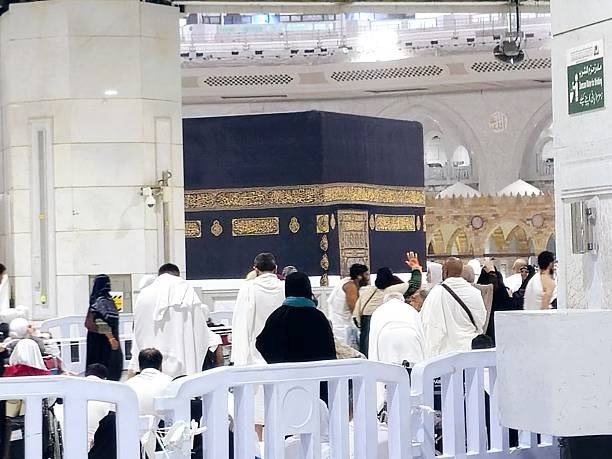
Hajj, the Pilgrimage to Mecca, is the fifth and most sacred pilgrimage in Islam. Every financially stable, physically fit Muslim should do this at least once in their life. Hajj. This ritual is performed in the month of Dhul-Hijjah. Evidence of great devotion, self-sacrifice, and love of Allah abounds in this ritual. This sacred journey symbolises harmony, peace, and Muslims’ obedience to Allah’s ﷻ.
Perform Hajj According to the Sunnah
Both spiritually and historically, Hajj is rather essential. Pilgrims preserve the customs of Prophet Ibrahim and his children. Bestowing honour on them and demonstrating their zeal and sacrifice. The majority of UK Muslims search for authentic Hajj packages to ensure their travel, accommodation, and medical needs are hassle-free.
Preparing for Hajj: Sunnah Recommendations
Preparing properly creates a smoother, more spiritually fulfilling experience. Sunnah guidance includes:
- Making sincere intention (niyyah) only for the sake of Allah
- Clearing outstanding debts
- Seeking forgiveness from family and friends
- Learning the rulings before travelling
- Maintaining patience and good manners throughout the journey
Performing Hajj with knowledge adds value to every step.
Ihram and Intentions
Two of the first fundamental things to perform Hajj are niyyah of cleanliness and the ornament of Ihram. Once the niyyah is done, Muslim pilgrims have substituted Ihram- two unstitched white clothes for males and a lady’s Abaya, a loose outer covering over the entire body. Pilgrims must announce Talbiyah once they have entered Ihram, along with everything sinful. Already residents of Makkah, Muslims would add elements of Hajj and Umrah to their journey. Then Muslims begin seven counterclockwise circles around the holy Kaaba, known as tawaf. They usually end tawaf in prayer and head for the second leg of Umrah, on the back side of Maqam Ibrahim between the mountains Safa and Marwa. Umrah pilgrims complete their pilgrimage and then proceed to Mina for the Hajj procession.
Mina, or “City of Tents”
5 or 6 kilometres from Makkah, there is a small town called Mina. Pilgrims are requested to stay overnight and remain in the tent city of Mina upon their arrival. Booking a Hajj visa in advance is crucial for most UK Muslims, as it allows them to access the holy land without delay.
All five Salahs are recited by the pilgrims between Fajr prayer and Zuhr prayer while residing in Mina. The land where Mina is located today is covered with tents. Fard and non-fard prayers obligatory for Muslims to read after residing in Mina must be performed by them.
Mina to Arafat, 9th Day of Dhul-Hijjah
On the ninth day of Dhul-Hijjah, pilgrims at Arafat recite Talbiyah while Muslims pray Zuhr and Asr. They recite duas if they are within the boundary of the Arafat. It is also known as Wuquf, standing before Allah (SWT) and read in a nearby place within the boundary of Jabal al-Rahmah from noon until evening.
Muzdalifah
Pilgrims journey to Muzdalifah, the second Hajj site, a suburb halfway between Mina and Mount Arafat. Pilgrims doing the evening prayer in Muzdalifah fields at sunset do Maghribaen – Isha and Maghrib together. Many UK Muslims meet fellow believers here, in one sense, as a sign of humility and oneness, under the open sky. Early on the tenth of Dhul-Hijjah, pilgrims gather 49 small, matching stones for distribution during the Rami ritual, as many others do.
Rami (Stoning the Devil)
Pilgrims, such as Mina pilgrims, act at Rami by stoning Jamarat al-Aqabah. Seven stones are thrown on the pillar complex. Rami performs Rami during the noon time daily. Rami doesn’t every day. Outside Ten and Twelve of Dhul-Hijjah, Rami is grabbed.
Nahr
Following Rami, on 12th Dhul-Hijjah, Muslim pilgrims are required to offer an offering of sacrifice, and they are allowed to sacrifice a camel or a lamb. Pilgrims may buy sacrifice coupons or vouchers, upon which the sacrifice will be indicated, so that it has been done on their behalf. The meat of the sacrificed animal should be distributed among poor persons.
Halq and Taqsir
Halq is shaving, while Taqsir is cutting or clipping. They must clip or shave their head when giving the blessed sacrifice. She is not required to shave as a female pilgrim, so she must clip a single strand or lock of her hair.
Farewell Tawaf
After completing all the rituals of the hajj, pilgrims return to the Holy Kaaba. At this spiritual holy Kabba, they will do the final tawaf of the hajj known as “Tawaf al-Wada’. After this Tawaf, they will do the Sa’i. So this is officially the End of the Holy pilgrimage. But some people also visit Madina before returning home.
Conclusion
Hajj is more a spiritual, religious journey that completely changes the pilgrim’s life than a physical one. It is essential to teach children about Hajj and Umrah from an early age, so they understand the significance of this sacred pilgrimage. At Hajj, Muslims are pardoned, given a new life in Islam, and guided on how to live Islam as a way of life. This transformative experience strengthens the Muslim Ummah worldwide, promoting unity, obedience to Allahﷻ, and devotion to the faith.